

Urban habitat project in the desert
Experimental city in the Atacama Desert

The engineering and design team spent hundreds of hours working on this project, taking into account all kinds of factors, desert climates and seasons, to understand and incorporate conditions of micro and macro sites, infrastructure and macrostructures.
We observe the needs of the visitors and map and analyze the real enclaves of the arid zones to develop future scenarios and determine their potential for implementation.
The reinvention of the landscape of the arid zones also goes hand in hand with its rediscovery by the agronomists, geographers, landscapers and engineers. Dozens of them contributed ideas about what they think the arid zones can give themselves as a new frontier of exploration and colonization and as the future granary of Humanity. To this end, planning principles and design strategies are based on a deep understanding of the inherent attributes of arid zones and their potential as a generator of vital space and advanced agricultural space.

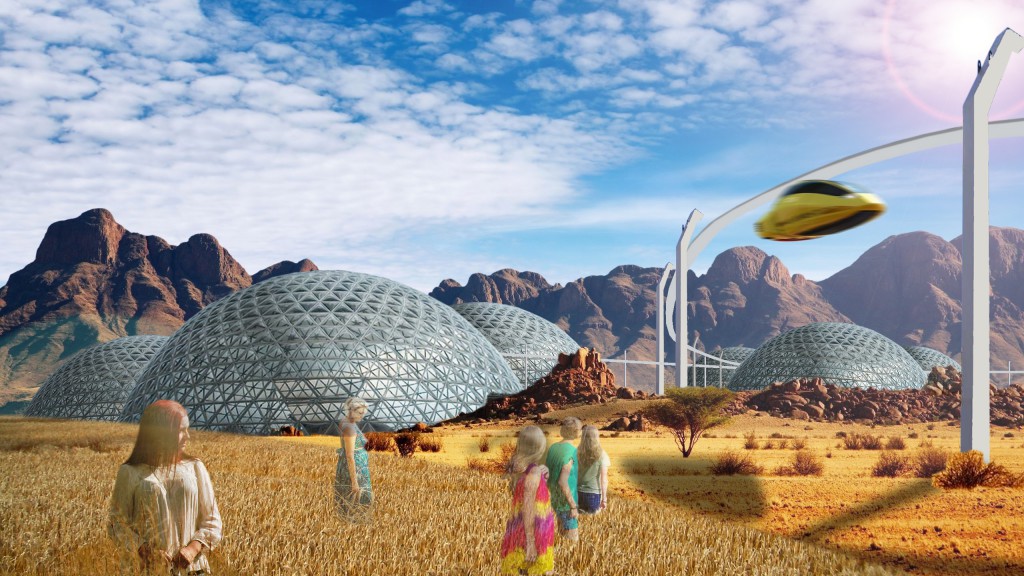
The arid zones offer a new world of possibilities, an extraordinary vital resource and the opportunity to experience the sensations of a green oasis surrounded by sand, rock and sky. The future network of barn cities will emerge as a new space for accommodation and residence, and a space that will generate food that will alleviate supply problems.
A master plan to invent a new concept of city based on the use of the resources and possibilities offered by the desert, to create a life system capable of sustaining a large population, in a resilient and equitable way and to increase the access of the human population to new areas of the planet, until now unpopulated.

A SYSTEM AT A POINT OF TURN
In a world as active and diverse as today, a new model of cities necessary to guarantee human survival by guaranteeing natural resources that are a common good.
However, the global urban system cannot continue to grow by destroying the planet’s surface, at the expense of natural areas and farmland. For this reason, deserts are currently standing as an opportunity to redirect urban growth in a sustainable way, generating vital and environmental resources, instead of squandering them. We face unprecedented environmental and economic challenges, and current urbanization processes do not fully meet the needs of the planet or the needs of citizens. Today’s cities and urban spaces today are lethal for the quality of life; recent development has outpaced the growth of green spaces. Additionally, cities lack access to the nature experiences and outdoor lifestyles that our planet naturally offers. In response, the Desert City Plan seeks to regenerate the urban system of arid areas, meet the needs of their communities, and expand access to resources through advanced urban technology.